Posts

Showing posts with the label math

The Exponential Backlog Theorem

Image
Perhaps you've come across the saying "The more you know, the more you don't know."  I find it applicable to science: how new discoveries lead to more inquiries, how answers lead to more questions. I think a similar rule could apply to work, specifically, arrears of work. I call this the Exponential Backlog Theorem. This theorem can be stated as "The more you work you do, the more work there is left to be done." This statement does not defy the elementary laws of algebra. It simply happens that sometimes, as we plough through backlog work, we discover more work that needs to be done.  And this could happen several times in the process, that instead of feeling that we are finishing work, we instead feel that we are now more buried with work than when we've started. The proof of this theorem is, as you've guessed, trivial. And, following the age-old tradition of scientific publications, the proof is left for the readers as an exercise.  く -...

Happy Pi Day: A Haiku and a Trivia

Image
Today is Pi Day. Happy Pi Day everyone! March 14 is celebrated in the Geek World as International Pi Day. The derivation of this celebration, being straightforward, is left for the readers [1],  following the great tradition of math textbooks. I wish to join today's celebration by presenting an original haiku (a form of short Japanese poetry) and a well-known trivia. Pi Haiku Circumferential Pi A point went around Its distance traveled divided by twice the length of a rotating arm Behold! Pi is in hand. Pi Trivia Do you want to remember the value of pi up to 14 decimal places?  Just memorize the sentence below.  "How I need a drink, alcoholic, of course, after the heavy lectures involving quantum mechanics." The number of letters in each word gives out the digits of pi in order.  You should be able to get 3.14159265358979. Photo credit: "Pumpkin Pi" by bigfoot13 in www.sxc.hu ------ [1] But we provide the sol...

Rewards of Teaching

Image
Since August this year, I have been going to a public school in Cebu together with some volunteers from a private high school . We give Math and English tutorials to some Grade 4 & 5 students.  Every week is a good experience for me, since, by talking to these kids, I get to practice my elementary Cebuano without fear of committing mistakes. But my experience this Saturday was special. I was tutoring Math. The topic was conversion of decimals, fractions and percent.  I began by tackling the concept of percent in Bisaya to them. Then I thought of translating "percent" to Bisaya so that they can understand it more.  I translated it as "kada gatos". I was overjoyed when I noticed how they immediately got the idea of percent afterwards. Then I wanted to teach them how to convert percent, decimals and fractions. I thought of the table below then began giving them easy drills.  Of course most of them got the correct answers.  They were even racing against each...

Trip around the Möbius Strip

Image
I lost a turn driving to the airport today and ended up in a department store called SM.  Driving from the airport, I lost a turn again and I ended up in SM once more. Suddenly, I thought that I was in a  möbius strip. Or, you could say, I had a möbius trip. A möbius strip is a surface with only one side and one edge.  You can make a mobius strip by getting a strip of paper, giving it a half twist (180 degrees), then joining the ends together. Möbius Strip by David Benbennick The möbius strip has many curious properties. In an ordinary cylindrical strip (ends joined together without a twist),  if you start from the seam then draw a line around the strip, you end up in the same starting point, in the same surface. In a möbius strip, drawing a line from the seam, then around the strip, will bring you to the "other side" of the strip. The möbius strip is studied in the field of mathematics called topology. An ant walking along a mobius strip can cover "both ...

17 Again : Discovering the Fountain of Youth

Image
I’ll be celebrating my birthday in a few days time. I’ll be 17 again! Yes, I have discovered the Fountain of Youth! The  Fountain of Youth that has evaded many explorers and philosophers for ages! The thing is, they were looking for it at the wrong places! The Fountain of Youth is to be found in Math, in Number Theory, in the Base Number System! I was 17 turning  18 when I found out I could remain 17 forever by simply changing the base number system when calculating my age! The day I turned 18 (Base 10), I decided to say goodbye to the Decimal System (at least in computing for my age) and adopted the Undecimal Number System (Base 11) so that I’ll be 17 again. The following year, I adopted the Duodecimal Number System (Base 12), and thus, I was 17 again!  As  I approach another birthday, I’ll be 17 yet again. But please, don’t ask me which Base Number System I will be using then . We are most familiar with the Decimal Base Number System.  In grade s...

Recession hits mathematicians

Image

Baby Names

Image
My chemistry teacher one time came to class with her daughter. She said, "Class I want you to meet my daughter, Chlorine." My classmates and I began to snicker. We wondered whether her other children are named Fluorine, Bromine, Iodine and Astatine, and that, in fact, their family name is actually "Halogen". In college, I found out that one physics professor named his children after atomic particles and subparticles. At least I'm sure that one of his children is named Atom. It's quite amusing how some people name their children after things related to their field of work. With this blog entry, I would like to suggest names for babies, depending on the field of interest or work of the parents. The list is not exhaustive (of course!). Feel free to give your own suggestions. Is your field not here? Well, why not make a comment and add your suggestions! ***** Like Asymptotes on Facebook : http://www.facebook.com/Asymptotes Follow Asy...

Math In Nature

Image
Enjoy this intellectual, musical and visual treat about math and nature from a film by Cristobal Vila . Great presentation concept, nice graphics, good music, and of course, great math!    

Irrational Love (why true love is like an irrational number)

Image
In mathematics, an irrational number is any real number that cannot be expressed as a fraction of two whole numbers. Two of the best-known irrational numbers are pi and e (Euler's number). The decimal expansion of an irrational number is non-repeating and non-terminating. This is not the case with rational numbers (for example 1/4 can be expressed in decimal form as 0.25 - which  terminates with the digit 5; 1/3 , on the other hand, is expressed in decimal form as 0.333333... , in which the digit 3 repeats ad infinitum ). Below is a verse which relates irrational numbers with true love. Trivia Below is an interesting trivia on how pi , an irrational number, is used in the software versioning of TeX , a typesetting software popular among scientific journal-writers. TeX has an idiosyncratic version numbering system. Since version 3, updates have been indicated by adding an extra digit at the end, so that the version number asymptotical...

Deadline Limit Theorem

Image
For a proof, you may try asking the following persons: a student trying to finish his thesis a graduate student submitting a journal article for peer review an accountant at the end of the financial fiscal year an executive preparing a report for the board of directors or, you may take a look at your own experience of trying to beat a deadline!

Youngblood: Faith and reason

Image
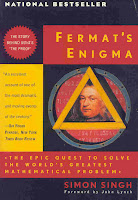
Fermat's Enigma by Simon Singh FAITH is reasonable, while science, to some extent, is founded on faith. These are two conclusions I made after pondering the relationship between faith and science. It was a "mathematical novel" I read recently that influenced me to undertake the exercise. The book, titled "Fermat's Enigma," was written by Simon Singh, a Ph.D. in particle physics at the University of Cambridge. It tells of the epic quest to solve Fermat's Last Theorem, regarded as the greatest mathematical problem of all times. I could say that the exercise led me to some rather startling discoveries. (Click here for a  brief explanation on Fermat's Last Theorem ) First, not everything in science has a proof. In fact, the whole of math, an abstract branch of science, is founded on statements that are so fundamental that they do not have proofs! These statements, called axioms, are either self-evidently true or else are assumed to be true. Perso...

Fermat's Last Theorem on Facebook

Image
Fermat's Last Theorem (FLT) is perhaps the most famous mathematical puzzle of all time. It was formulated as a conjecture by Pierre de Fermat in 1637 and was only proven in 1995 by Andrew Wiles. FLT states that no three positive integers  a ,  b , and  c  can satisfy the equation  a n  +  b n  =  c n    [1] for any integer value of  n  greater than 2. A very interesting fact about FLT is how Fermat introduced it to the world. He wrote the following on the margin of the book Arithmetica : I have discovered a truly marvelous proof that it is impossible to separate a cube into two cubes, or a fourth power into two fourth powers, or in general, any power higher than the second into two like powers. This margin is too narrow to contain it. With this seemingly casual and yet bold statement, Fermat issued a challenge to the great mathematical minds of his time (which included Blaise Pascal) and of the three cen...

Statistician at Dinner

Image

The ultimate multiple choice exam

Image
People tend to think that exams would be much easier if they're in multiple-choice format. But does having more choices really make them easier? Consider the test item below: Who among the following scientists contributed to the atomic theory? A.) John Dalton B.) Charles Darwin C.) J.J.Thompson D.) Albert Einstein ... ... ... S.) All of the above T.) All letters above that are valid Roman Numerals U.) All letters above that correspond to a Fibonacci number V.) All letters above which are valid symbols of an element in the periodic table W.) All letters above which are elements of the union of the sets in U and V X.) All letters above which are elements of the intersect of the sets in V and W Y.) None of the above Z.) Sirit (Filipino word for ¨I give up¨)   Post Script A few lessons we can gather from the above post: * Having a lot of choices may not be good all the time. * No matter how many choices you have, you always have to choose the right one. * ...

Beauty in Math: Euler's Irrational Imagining

Image
The poem that follows is a tribute to Euler's magnificent observation that : Euler's Irrational Imagining i to the i you equal, do you not, one over the square root of e to the pi ? What is interesting about the above equation is the fact that it involves 3 of the most important numbers in Math: the imaginary number i , and the irrational numbers e (Euler's number) and pi . Morover, it shows that an imaginary number raised to an imaginary number could actually result in a real number! Contemplating this equation, one could not but appreciate the inherent beauty that exists in math. Sidelight   I consulted a professor one time.  We discussed the graph output of the results of my experiments.  After staring at the graph for a couple of seconds, he suddenly smiled and said "It's beautiful, isn't it?" Of course, I could not disagree, lest he gives me a failing mark. So I just parrot him and said "Uhmm..ah...yes... it...

Proof found to a very difficult mathematical problem

Image
Note: You need to know Tagalog/Filipino to appreciate this proof.  Problem: Prove the following: log 2   = z   n Proof Expanding the Left Hand Side of the equation: log two = z n Substituting phonetically log tu = z n Expanding the Right Hand Side of the equation... log tu = zzzzzzz.... Using the commutative property: tu log = zzzzzzz.... Q.E.D.

Kwentong Peyups: Beyond the Limits of Calculus

Image
It's been more than ten years since I took up differential and integral calculus (more familiarly known as Math 54) during my college days in UP Diliman. I've long forgotten most of the formulas and techniques I learned then, but the memory of the person who taught them to me remains vivid. She was Ma’am K. The first thing that struck me about Ma'am K was her mastery of the subject she was teaching. She would explain things with conviction and authority, even reciting long theorems from memory. She also remained focused on the exposition of the lesson. Once, while teaching, the chalk fell off her hand, but she continued with the discussion even as she was picking it up from the floor. Later on, it became obvious to me that she possessed an extraordinary intelligence. But Ma’am K was not just an intelligent instructor, she was also a competent one. I've met some very intelligent professors in U.P., but many of them, sad to say, do not know how to teach. They s...

Street Math: How to get spoon and fork in food courts efficiently

Image
Problem In many food courts (at least in the Philippines), spoons and forks are usually kept in a 2x2 container (2 rows and 2 columns), such as the one shown below.   What would be the optimal way of getting utensils such that the probability of getting 2 of the same kind (2 spoons or 2 forks, instead of 1 spoon and 1 fork) is kept to a minimum? Solution Get the utensils which are oriented diagonally to each other. Why it works   There is a great chance that the spoons and forks will be alligned in a row or a column (human psychology, perhaps?). Thus, getting the utensils which are oriented diagonally to each other will most likely yield utensils which are not of the same type. Comment s I have been using this principle for a long time already and I have only failed once. Whenever I am able to get 1 spoon and 1 fork correctly, there is some feeling of gratification.  You should try it next time you are in a food court! Image from : http://www.ebay.com....

Everyday Math: How to know how many pages there are from StartPage to EndPage

Here is a simple calculation for everyday living. Problem You want to print pages 23-45 of a file. How many pages will you make? Solution Formula: EndPage-StartPage+1 Example Printing pages 23-45 will produce (45-23)+1 =23 pages

Everyday Math: How to know what time it would it be x hours from now

Here is a simple calculation for everyday living. Examples: What time would it be 7.5 hours after 9:30AM? What time would it be 8 hours after 10:30AM? Solution 1. Compute CurrentTime+TimeToElapse 2. If the Sum is less than or equal to 12:00, the Sum is your answer. 3. If the Sum is more than or equal to 12:00: a. Subtract 12:00 from the Sum b. Switch from AM to PM or PM to AM depending on the which side CurrentTime is Examples Example1 7.5 hours after 2:00PM 2:00+7:30=9:30PM (we don't switch from PM to AM since the Sum is less than 12:00) Example2 7.5 hours after 9:30AM 9:30+7:30=17:00 17:00 is greater than 12:00   So we subtract 12:00 from the Sum -> 17:00-12:00=5:00 Then we switch from AM to PM Therefore the answer is 5:00PM Example3 8 hours after 10:30AM 10:30+8:00=18:30 18:30-12:00=6:30 Switch from AM to PM: Answer is 6:30PM